
Library Record
Images
Additional Images [6]
Metadata
Catalog Number |
2016.25.73 |
Accession number |
2016.25 |
Object Name |
Book |
Title |
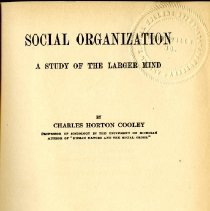
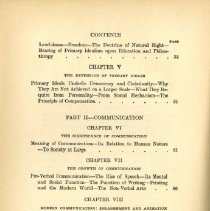
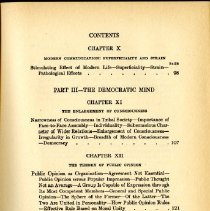
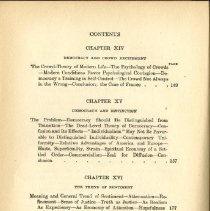
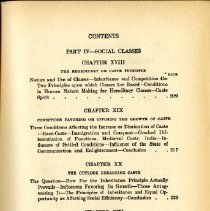
Social Organization A Study of the Larger Mind |
Published Date |
1922 |
Summary |
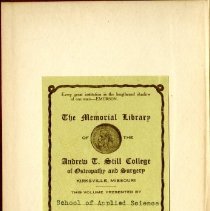
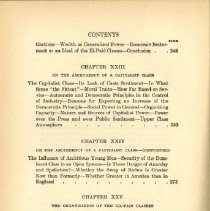
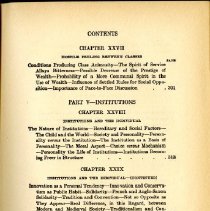
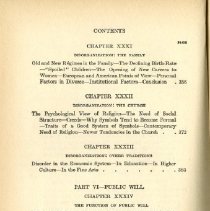
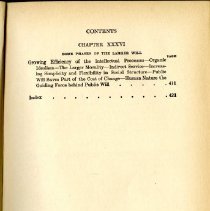
Social Organization A Study of the Larger Mind; 1922. Written by Charles Horton Cooley, published by Charles Scribner's Sons in New York, red cover with gold lettering on spine, Memorial Library sticker on interior front cover "School of Applied Science"; 14 cm (w) x 20.5 cm (h), 436 pages. Spine cover heavily faded and discolored, black paint on base of spine with call number written in white, small yellow sticker on spine, top spine extreme worn, paper yellowed, acid burn around edges of interior covers and textblock, "Property of KCOS Library" stamped around edges of textblock, library outcard attached to interior back cover. |
Credit line |
Museum of Osteopathic Medicine |
People |
Abbott, Lyman Addams, Jane Anderson, W.L. Augustine Austen, Jane Bacon, Francis Bagehot, W. Baring-Gould Bourget, Paul Brooks, John G. Browne, Sir T. Brownell, W. C. Bryce, James Buck, Winifred Burckhardt Burke Burne-Jones Burroughs, John Carlyle Carnegie, A. Commons, John R. Cooley, Charles Horton Cornish, F. W. Dante Darwin De Tocqueville, Alexis Dellenbaugh, F. S. Descartes Devine, E. T. Dill, Samuel Donovan, J. Dorsey, J. O. Ellis, H. Emerson Ennui Galton, Francis Garibaldi Gibbon, Edward Goethe Green, J. R. Gummere, F. B. Hamerton, P. G. Hart, R. L. Heine Herbert, George Higginson, T. W. Howard, George E. Howells, W. D. Huxley James, Henry James, William Jesus Jevons, W. S. Johnson, Doctor Johnson, Samuel Keller, Helen Kemphis, Thomas Kropotkin, P. A. Lamb, Charles LeBon, G. Lecky, W. H. H. Lee, H. C. Lee, Joseph Lincoln Lindsey, Judge Lloyd, A. H. Lloyd, H. D. Longinus Lowell, J. R. Machiavelli Mackenzie, J. S. Napoleon O'Brien, R. l. Ostrogorski Pater, Walter Patten, Simon N. Paul, St. Roberts, lord Rodin Roscommon, Earl Ross, E. A. Schiller Sedgwick, H. D. Sighele Sill, E. W. Smiles, Samuel Smith, A. H. Spahr, Charles Spencer and Gillen Spencer, Herbert Spinoza Sturgis, Russell Sullivan, Miss Symonds, J. A. Tarde, Gabriel Tennyson Thackeray Thoreau Tolstoi Tout, T. F. Van Brunt, Henry Veblen, T. V. Westermarck, Edward Wharton, Edith Whateley Whitman Woods, Robert Woolman, John Wordsworth |
Search Terms |
Achilles Agreement not essential to public opinion Alphabet Amenomori Anarchism Anarchism in the church Anarchy and spoliation fear of Ann Arbor school carnival Architecture as communication Architecture disorganization in Aristocracy hereditary Army American Army German Art collective judgments on Art disorganization in Art in relation to democracy Art spirit of Art visible society a work of Arts non-verbal as communication Ascendency of a capitalist class Assemblage public Athletic sports Attenuation of sentiment Autocratic control of industry Average theory of group action Biological type Birth rate decline Blame Brotherhood sentiment Campfire assembly around Capitalist class Capitalist class ascendency Carnegie views on wealth Caste Change social in relation to caste Character of recent changes Checkbook in social reform Chicago Chicago recreation centers in Child his relation to the world Children development of social consciousness Children reforms in the interest of Children spoiled China lack of communication in Chinese Chivalry Choice excessive Choice versus mechanism Christianity Church Church disorganization in City life Class animosity Class atmosphere Class consciousness Class struggle Classes capitalist Classes hostile feeling between Classes open Classes open in relation to wealth Classes organization of the ill paid Classes social Classical culture Clergymen facial expression Commercialism Commercialism in relation to art Communication Communication growth of Communication in relation to caste Communication in relation to crowds Communication in relation to superficiality and strain Communication modern a cause of enlargement and animation Communication modern in relation to individuality Communication significance of Community ideal Compensation principle in social organization Competition Comte Conditions favoring or opposing the growth of caste Conditions producing class animosity Conflict Confusion in relation to art and literature Confusion to sentiment Conquest a cause of caste Conscience public Consciousness development in children Consciousness growth of in history Consciousness public Consciousness social Conservatism Constitution of the United States Convention and tradition Conventionalism Cost of change Country life effects of Courage Creeds Crime Crises commercial Crowd excitement in relation to democracy Crowds psychology of Crowd-theory of modern life Cuba Culture groups and types Dead level theory Declaration of independence Demand economic often degrading Democracy a discipline in self-control Democracy among children Democracy an inadequate name Democracy and crowd excitement Democracy and distinction Democracy as mental organization Democracy dependent upon printing Democracy in relation to wealth Democracy relation to modern communication Democracy source of its ideals Democracy to childhood Democratic mind Determinism moral value of Dialects revival of Diffusion a result of modern communication Diffusion not opposed to selection Diffusion possibilities Diffusion the age of Diffusion zeal for Discussion Disorder in the economic system Disorganization in education and culture Disorganization in fine art Disorganization in industry Disorganization in the church Disorganization in the family Disorganization other traditions Disorganization spiritual Disorganization the church Disorganization the family Distinction apt to cause isolation Distinction in relation to democracy Divorce Domestic service Dress Drink Economic interpretation of history Economic system confusion in Education Education disorganization in Education formalism in Education of women Education public Efficiency social depends upon freedom Emulation Energy persistence England Enlargement of consciousness Environment Equality Ethics Eugenics Extension of primary ideals Facial expression Family Family as a primary group Family as a source of primary ideals Family disorganization in Family traditional careers in Fashion Fellowship Ferguson on architecture Feudal system Formalism Formalism and disorganization Fort Sumter attack on France Frederick the Great Freedom as a primary ideal Freedom two aspects of in relation to classes Freewill Function of public will Gangs of boys as primary groups Genius Germany Gesture God Gossip organized Government as public will Government not the only agent of public will Government sphere Government transformation Greece refinement in Greed of gain Groups primary Growing efficiency of the intellectual processes Growth of communication Haste Hereditary or caste principle Heredity and environment History organic view Holbein Honesty and policy Hopefulness Horace Hostile feeling Hostile feeling between classes House of Commons How far wealth is the basis of open classes Human nature dependent upon communication Human nature relation to primary groups Humanism of sentiment Idealism organic Ideals of groups Ideals primary Imitation two kinds Immigrants Immigration Impersonal character of open classes India caste in Indians American individuality among Indians American kindness among Individual in relation to institutions Individualism domestic Individualism in art Individuality development in history Individuality enjoyment Individuality how affected by modern communication Individuality in harness Individuality in relation to democracy Individuality in tribal life Individuality moral Influence of ambitious young men Inheritance principle Innovation as a personal tendency Institutions Institutions and the individual Institutions in relation to privileged classes Intolerance Introspection sympathetic Italy Japan Justice sentiment Kindness Labor movement Labor troubles Latin language Law students Lawfulness as a primary ideal Lawyers Leadership Literature disorganization Literature growth of refinement in Literature in relation to democracy Literature of social knowledge Loyalty Luther Luxury Macaulay on democracy Maladjustment as a cause of poverty Malthus Manners tendency Mantegna Manual training Marriage Masses in relation to public opinion Masses the initiators of sentiment Meaning and general trend of sentiment Meaning of communication Meaning of poverty Meaning of primary groups Middle ages caste in Might and right Milton Mind an organic whole Mind cure doctrines Mind democratic Mind organic view of Mir Russian Mob Modern communication enlargement and animation Modern communication individuality Modern communication superficiality and strain Money value nature Montesquieu Moral aspect of institutions Moral aspect of public will Moral aspect of the organic view Moral aspect of the organic view of mind Moral principles need settled Moral unity Morality international Morality mode of progress Morality of capitalists Morality of group action Morality specialization in Morality the larger Music as communication Narrowness of consciousness in Tribal Society Nationality persistence Natural right doctrine of relation to primary ideals Natural selection Nature and nurture Nature and use of classes Nature of formalism Nature of institutions Nature of open classes Nature of primary idealism Nature of the sentiment of brotherhood Need of class organization Negro question Negroes Neighborhood the Newspaper in modern communication North Carolina mountain people of Old and new regimes in the family Omahas war party among Open classes Opinion public Opportunity freedom of Opposition morality of Organic conception of society Organic idealism Organization of the ill-paid classes Organization social Organizing capacity Originality of masses Outlook regarding caste Painting Paralysis general Paul on truth Personality interest in at elections Personality relation of to social organization Personality to specialization Persons judgment of by the masses Philanthropy Plato Play group Politics rule of public opinion in Portraits old and new Poverty Power social nature of Power the deepest of instincts Prestige of wealth Pre-verbal communication Prigs lack of in France Primary aspects of organization Primary groups Primary ideals Primary ideals underlie democracy and Christianity Principles supplanting formulas Printing the basis of democracy Privilege apt to cause isolation Professional classes Progress a modern idea Progress cost Progress irregularity of Psychological view of religion Public and private will Public opinion Public opinion as organization Public will Punishment Question Race capacity Race question Realism Refinement tendency toward Religion Renaissance Resentment Responsibility Roman Empire Ross on the larger morality Ross on the mob mind Rules of the game Ruskin Russia Sculpture Self-consciousness inseparable from social consciousness Self-expression the fundamental need Self-words a study of the early use Sentiment how affected by communication Sentiment individuality Sentiment leadership in by the masses Sentiment meaning and trend of Sentiment religious Sergeant Service as a primary ideal Service ideal of Service indirect Service spirit of Sexes differentiation Significance of communication Social and individual aspects of mind Social classes Social consciousness Social salvation Social structure increasing simplicity and flexibility of Socialism Socialism municipal Socialism state Sociology Solidarity of classes Solidarity of nations Some phases of the larger will Spain class feeling in Specialization in philanthropy Specialization not opposed to democracy Specialization of opinion Speech mental and social functions of Speech origin and growth of Stimulating effect of modern life Strain Strike general Struggle for existence among ideas Students University Suffrage popular Suggestion Suicide Sullivan Helen Keller teacher Superficiality Survival of the fittest Sweating system Symbols religious Sympathy as the basis of reform Tariff Telegraph effect of on language Theory of public opinion Three conditions affecting the increase or diminution of caste Tradition and convention Traditionalism Tranquility lack of in art Transition distinguished from democracy Trend of sentiment Truth as a primary ideal Truth sentiment Types social Unconscious social relations Unfit are the poor Uniformity of American life Unions University of Michigan supported by popular suffrage Variation of ideas Vulgarity of wealth and privilege Watts Mammon Wealth as the basis of open classes Wealth comparative ascendency Wealth inheritance Wealth prestige Wealth use of We-feeling What the masses contribute Will government as Will public Will some phases of Winckelmann Women opening of new careers to Worry a cause of poverty Writing social function Wrongs social not willed Young men in relation to classes |