
Library Record
Images


Metadata
Catalog Number |
2015.42.07 |
Accession number |
2015.42 |
Object Name |
Book |
Title |
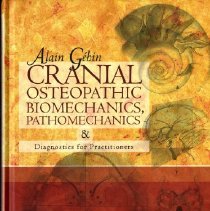
Cranial Osteopathic Biomechanics, Pathomechanics & Diagnostics for Practitioners |
Published Date |
2007 |
Summary |
Cranial Osteopathic Biomechanics, Pathomechanics & Diagnostics for Practitioners; 2007. Written by Alain Gehin, published by Churchill Livingstone Elsevier in Paris, written in English, red and yellow background with black and maroon lettering on the front, black and white drawings of the brain and cranium on teh front, information about the book and author on the back; 19.5 cm (w) x 25.2 cm (h), 193 pages. No visible damage. |
Credit line |
Museum of Osteopathic Medicine |
People |
Gehin, Alain |
Search Terms |
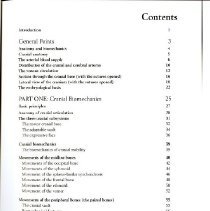
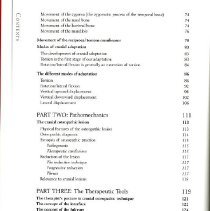
Gehin, Alain Anatomy and biomechanics Cranial anatomy Arterial blood supply Distribution of the cranial and cerebral arteries Venous circulation Section through the cranial base Lateral view of the cranium Embryological basis Cranial biomechanics Basic principles Anatomy of cranial articulation Three cranial subsystems Motor cranial base Adaptable vault Expressive face Cranial biomechanics Biomechanics of cranial mobility Movements of the midline bones Movements of the occipital bone Movements of the sphenoid Movement of the spheno-basilar synchondrosis Movement of the frontal bone Movement of the ethmoid Movement of the vomer Movements of the peripheral bones Cranial vault Biomechanical features Movement of the temporal bone Movement of the pivots of the temporal bone Three pivots of the cranial base Three pivots of the vault Movement of the parietal bone Movement of the facial bones Movement of the central maxilla-palation-vomerian complex Movement of the maxilla Movement of the palatine bone Movement of the Zygoma Movement of the nasal bone Movement of the lacrimal bone Movement of the mandible Movement of the reciprocal tension membranes Modes of cranial adaptation Development of cranial adaptation Torsion is the first stage of our adaptation Rotation lateral flexion is generally an extension of torsion Different modes of adaptation Torsion Rotation lateral flexion Vertical upward displacement Vertical downward displacement Lateral displacement Pathomechanics Cranial osteopathic lesion Physical features of the osteopathic lesion Osteopathic diagnosis Synopsis of osteopathic practice Pathogenesis Therapeutic conclusions Reduction of the lesion Inductive technique Progressive reduction Thrust Relevance to cranial lesion Therapeutic tools Therapists posture in cranial osteopathic technique Concept of the interface Concept of the fulcrum Therapeutic palpation Symbiosis between patient and therapist Manual diagnosis Manual approaches Vault approach Fronto-occipital approach Bimastoid approach Spheno-mastoid approach Detection and release of an abnormal bevel Diagnostic approach Osteopathic diagnosis Manual diagnosis in cranial technique Identification of the four quadrants Manual assessment of the four quadrants Temporal bone Temporal lesion Petro-basilar test Petro-jugular test Condylo-squamo-mastoid test Hinge-mastoid test Test for the spheno-squamous pivot Test for the petro-phenoid pivot Summary of the tests for the temporal bone pivots Specific tests for the sphenoid Intrasphenoidal test Stylo-hyoid ligament Specific tests for the temporo-mandibular joint Suspensory ligaments of the mandible Stylo-mandibular ligament Spheno-manidbular ligament Lateral collateral ligament Test for the meniscus of the temporo-mandibular joint Specific tests for the ocular muscles Tests for the different ocular muscles Tests for the rectus muscles of the eye Test for the superior oblique muscle of the eye Test for the inferior oblique muscle of the eye |